
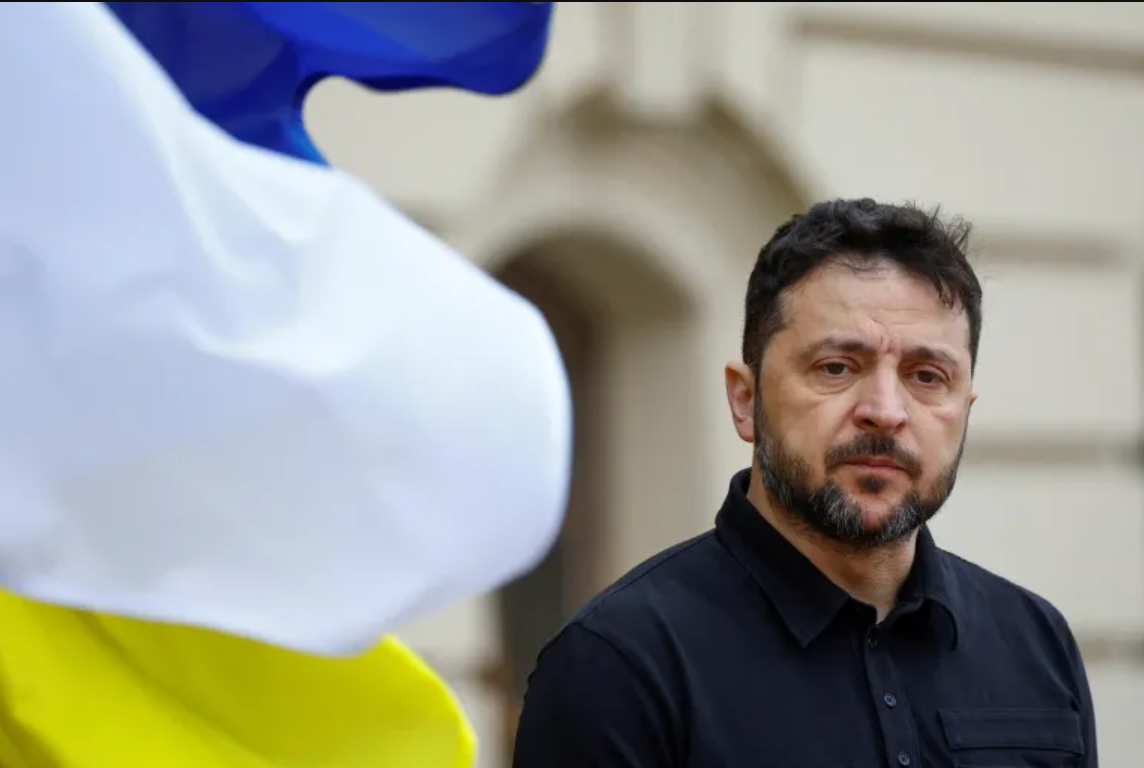
KYIV — Ukrainian President Volodymyr Zelenskyy has revealed new details of a revised peace proposal aimed at ending Russia’s war on Ukraine, while calling for direct, leader-level talks with Donald Trump to resolve what he described as the most sensitive and unresolved issue: territory.
Speaking to reporters in a briefing released Wednesday, Zelenskyy said Ukrainian and U.S. negotiators have made progress on several elements of a draft peace framework following marathon talks in Florida. However, he stressed that questions over control of eastern Ukraine — particularly the Donbas region — remain the biggest obstacle.
“We are ready for a meeting at the leaders’ level to discuss sensitive issues,” Zelenskyy said, adding that territorial matters cannot be settled by negotiators alone.
Donbas Remains the Hardest Issue
According to Zelenskyy, Ukraine and the United States have aligned on multiple points in the evolving 20-point plan, including allowing Ukraine to maintain its current peacetime military strength of about 800,000 troops and securing additional guarantees from Western partners.
But the fate of the eastern Donetsk and Luhansk regions — collectively known as the Donbas — remains unresolved. Zelenskyy called the issue “the most difficult point” in the talks.
Kyiv has proposed freezing the conflict along current front lines, while Moscow is demanding Ukraine withdraw from the entire Donetsk region. Ukraine still controls roughly a quarter of that territory and has rejected calls to relinquish it.
The U.S. has floated a compromise idea that would turn disputed areas into free economic zones, but Zelenskyy said Ukraine insists any such arrangement must depend on a public referendum.
Nuclear Plant and Security Zones
Another sticking point is the Zaporizhzhia nuclear power plant, Europe’s largest, which lies in Russian-controlled territory near the front line. Zelenskyy said Kyiv has suggested establishing a limited economic zone around the facility, though no agreement has been reached.
Under the draft proposal, Russian forces would also withdraw from parts of central and northeastern Ukraine, including regions near Dnipropetrovsk, Mykolaiv, Sumy, and Kharkiv. International troops would be deployed along the contact line to monitor compliance and prevent renewed fighting.
Because of deep mistrust toward Moscow, Zelenskyy said the proposed buffer zone would require international oversight to ensure the ceasefire holds.
Security Guarantees and EU Path
The draft peace framework also outlines strong security guarantees for Ukraine, modeled on NATO’s Article 5, which would obligate partners to respond to any renewed Russian aggression. Zelenskyy said a separate bilateral agreement with Washington would spell out how those guarantees work and how the ceasefire would be monitored using satellite and early-warning technology.
Other provisions include a defined path for Ukraine’s membership in the European Union, elections to be held after an agreement is signed, accelerated trade talks with the United States, and major reconstruction and investment funds.
Zelenskyy emphasized that Ukraine would retain control over how reconstruction funds are spent in areas it governs, calling that provision a key achievement in the negotiations.
Despite remaining gaps, the Ukrainian leader suggested the latest draft marks meaningful movement — even as he acknowledged that both Kyiv and Moscow may still be far apart on the compromises needed to end the war.