

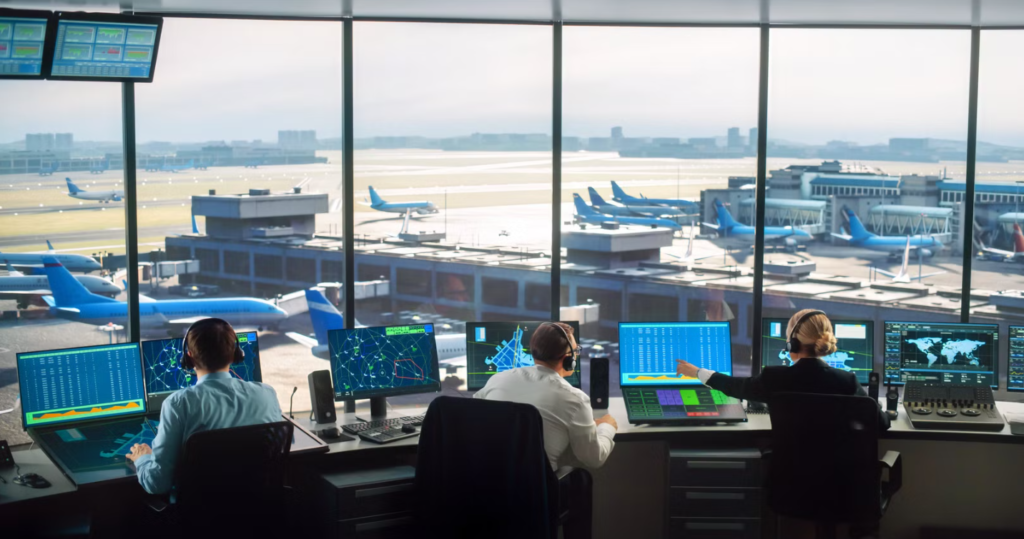
More U.S. air traffic controllers are taking their skills overseas, raising questions about why American taxpayers are funding training for professionals who ultimately choose to work abroad — and whether the Federal Aviation Administration is doing enough to keep them.
The growing exit of controllers comes weeks after reports that many rejected a $10,000 “Patriot Bonus” offered by the FAA after a government shutdown. Controllers reportedly viewed the bonus as a temporary fix that failed to address long-standing concerns about demanding schedules, burnout, and workplace morale.
Taxpayer-Funded Training, Overseas Jobs
According to a December report by The Wall Street Journal, dozens of U.S.-trained air traffic controllers have recently left for jobs in countries such as Australia, where workweeks are shorter and conditions are described as less stressful.
One of them, Chris Dickinson, left after a 13-year career in the U.S. to work in Australia, citing a 36-hour workweek compared with the standard 40 hours in the U.S. — a figure that reportedly climbed to as high as 60 hours during staffing shortages and the 43-day federal shutdown.
American taxpayers fund the lengthy and expensive training required to certify air traffic controllers. Critics argue that when those workers leave, the public effectively loses its investment.
Beyond Australia, U.S.-trained controllers are reportedly finding opportunities in Canada, Hong Kong, New Zealand, and the United Arab Emirates, where pay packages and work-life balance are seen as more attractive.
FAA Response and Low Morale
An FAA spokesperson said the number of controllers leaving the country is not unusual, though she acknowledged that morale among controllers declined sharply following the shutdown.
Controllers have said the shutdown forced some to take out loans or second jobs while working without pay — a breaking point for many in an already high-stress profession responsible for the safety of millions of passengers daily.
Hiring vs. Retention
The FAA plans to hire roughly 9,000 air traffic controllers by 2028 after a reported 13% drop in staffing between 2010 and 2024. But critics argue that aggressive hiring does little if retention remains a problem.
Some current and former controllers have criticized the agency’s training culture, describing it as harsh and discouraging. Others defend the approach, arguing that the job’s responsibility — managing the safety of nearly 3 million passengers per day — demands rigorous standards.
Passengers themselves are divided. While some call for higher pay and better conditions to keep skilled controllers in the U.S., others argue that tough training is essential for aviation safety.
A Growing Debate
As more controllers look abroad for better working conditions, the debate continues over whether the FAA’s policies are protecting public safety — or pushing highly trained professionals out of the country.
For now, the question remains: can the U.S. fix its air traffic control system fast enough to keep the people it spent years training?
[…] submitted by /u/hearing_hero[link][comments] […]
[…] by /u/hearing_hero [link] […]